
On this page
Opening a peptide programme takes about ninety days. Keeping one open is a different job entirely.
Almost every guide on this subject stops at the launch. Pick your compounds, find a pharmacy, sign a medical director, run some ads.
That part is well documented and, frankly, the easy part.
The part nobody writes about is month four, when the patients who signed up in month one quietly stop refilling. In weight management that is not a small leak. It is most of your panel.
This guide covers both. Nine steps to open a compliant peptide programme in the United States, and an honest look at the one step that decides whether it is still a business a year from now.
The nine steps
- 1. Decide the delivery model and the patient before anything else.
- 2. Get the legal structure right, ideally before you see a single patient.
- 3. Line up a compounding pharmacy you have actually vetted.
- 4. Write the clinical protocol, starting with the good faith exam.
- 5. Price it as a programme, not as a vial.
- 6. Build the tech stack on both sides: provider and patient.
- 7. Design the first ninety days of the patient's experience.
- 8. Market it without earning a warning letter.
- 9. Watch four numbers, every week.
Steps one to six get a patient to their first vial. Step seven decides whether there is a second.
Is now actually the moment?
Something genuinely unusual happened in July 2026, and it is worth understanding precisely, because the headlines have already blurred it.
On 23 and 24 July the FDA's Pharmacy Compounding Advisory Committee met to consider seven peptides for the 503A bulk drug substances list: BPC-157, KPV, TB-500, MOTS-c, emideltide (DSIP), Semax and Epitalon.1
The committee recommended six of the seven. BPC-157, KPV and TB-500 each passed 8 to 6 with one abstention. MOTS-c passed 7 to 5 with two abstentions.2 It did so against its own agency's scientists, who had reviewed all seven and recommended against every one.3
Three separate events, routinely treated as one
- Removal from Category 2. Twelve peptides came off the "significant safety concerns" list in April 2026 after their nominations were withdrawn. That removed a basis for enforcement. It did not create permission.4
- A PCAC recommendation. Advisory and non-binding. The FDA is free to disagree.2
- Actual placement on the list. Requires notice and comment rulemaking, which under normal timelines runs well past a year.3
So the honest read is this. Nothing became legal in July that was not legal in June. What changed is direction of travel, and the number of practices now deciding to build a programme.
That is the real reason to move now. Not because the rules loosened, but because your local competition is having this conversation this quarter.
Where you are starting from
The two routes into this look similar on paper and are almost nothing alike in practice. Be honest about which one you are on, because it changes the order of everything below.
| Adding to an existing practice | Opening a new clinic | |
|---|---|---|
| Time to first patient | 60 to 90 days | 6 to 12 months |
| Dominant cost | Legal review and software gaps | Medical director, lease, patient acquisition |
| Hardest part | Protocol and follow up design | Getting the first hundred patients |
| Biggest advantage | A warm patient base that already trusts you | No legacy workflow to fight |
| Most common failure | Bolting it on with no follow up plan | Burning capital before month twelve |
If you already have a prescriber, a chart system and patients, you are adding a service line and most of this guide is a checklist. If you are starting from zero, steps two and three sit on your critical path and everything else waits behind them.
1Decide the model and the patient
The most common mistake here is offering everything to everyone. It sounds like optionality. It reads to patients as a menu they cannot navigate, and it triples your protocol work.
Pick one vertical and one delivery model for the first six months.
The delivery model
| Model | Works when | Watch out for |
|---|---|---|
| In person | You have a location and a local reputation | Capacity is capped by chairs and hours |
| Telehealth | You want reach beyond your city | Licensing per state, exam rules per state |
| Hybrid | Initial visit local, follow ups remote | Two sets of workflows to keep in sync |
The patient
- Weight management. The largest demand pool by a wide margin, the most competitive, and the one with the worst retention profile. Everything in step seven was written with this group in mind.
- Hormone optimisation. Longer patient tenure, more lab work, better fit if you already run TRT or menopause care.
- Recovery and performance. Smaller, higher intent, and the group most affected by the compounding status of BPC-157 and TB-500.
- Longevity. Highest willingness to pay, smallest pool, and the hardest to make outcome claims about without stepping over a line.
Whichever you choose, start with one or two compounds rather than a formulary. It makes your protocols, your staff training and your marketing all point the same direction.
2Get the structure right first
This is the step people postpone, and the only one on this list that can end a career rather than a quarter.
Most states apply some form of the corporate practice of medicine doctrine. The principle is consistent even where the statutes differ: a non-physician cannot own a medical entity, cannot control clinical decisions, and cannot own the patient records.5
The mistake that keeps recurring
Founders form a standard LLC and start delivering telehealth through it. In Minnesota that is classified as the unlicensed practice of medicine, and the consequences reach the participating physician's licence.6 The compliant shape is a clean separation: a physician-owned professional corporation holding the clinical side, and an administrative management services organisation holding technology, marketing and billing.
What to settle before you open
- Entity structure reviewed by a healthcare attorney in every state you intend to treat in, not a general business lawyer.
- Medical director with an active unrestricted licence in each of those states, and a written scope that describes real supervision.
- Management fees set at fair market value on a defined basis, not as a share of clinical revenue.
- Patient records owned by the professional corporation, whatever brand the patient sees.
- Malpractice cover that explicitly names peptide and compounded therapy.
- Continuity plan for medical director turnover, so one resignation does not pause the practice.
On multi-state work, one detail catches almost everyone. There is no such thing as a telehealth licence. Every clinician treating a patient needs an active licence in that patient's state, and platforms that operate nationally typically run a separate professional corporation per strict-rule state.5
Start with two or three states. Fifty is a later problem.
A medical director who only lends a licence is not a shortcut. Paper supervision is a named enforcement risk.
3Sourcing you can defend
Your pharmacy relationship is a clinical decision and a compliance decision at the same time. Understand the two categories before you pick one.
| 503A compounding pharmacy | 503B outsourcing facility | |
|---|---|---|
| Compounds against | A prescription for a named patient | Batches, with or without patient prescriptions |
| Primary oversight | State boards of pharmacy | Registers with and is inspected by the FDA |
| CGMP required | No | Yes |
| Office stock | Generally no | Yes |
| Typical use | Patient-specific dispensing, often shipped direct | In-office administration, larger volume |
Source: FDA guidance on the provisions of sections 503A and 503B.7
Neither category means FDA approved. Compounded drugs are not reviewed by the FDA for safety, effectiveness or quality before they reach a patient, and they are not generics.8 That distinction matters clinically, and it matters again in step eight when you write your website.
Vetting a pharmacy
- Licensure in every state you ship to, including non-resident pharmacy licences.
- Inspection history and any FDA 483 observations or warning letters, asked for directly.
- Certificates of analysis available per lot, on request, without friction.
- Sterility and potency testing policy in writing, along with beyond-use dating.
- Formulary transparency about which substances they will and will not compound, and why.
- A written agreement covering recalls, out-of-specification notifications and adverse event handling.
- Turnaround times you have verified rather than been quoted, because a late refill is a churned patient.
Do not build a programme around a single compound whose status is unsettled. If BPC-157 is the whole offer and the rulemaking goes the other way, you have no practice left. Build around what is stable and treat the rest as upside.
4Write the clinical protocol
Everything downstream, including your defensibility in an audit, rests on the patient encounter being real and documented.
The baseline is consistent across states: a licensed prescriber reviews the history, performs a relevant examination, and documents the decision before treatment begins.9
What varies, and varies a lot, is whether that exam can be done by video or asynchronously, who is permitted to perform it, and how often it must be repeated. Assuming a workflow that clears in one state will clear in another is how practices fail audits.9
What the protocol has to contain
- Intake. Structured history, current medications, contraindications, goals. Structured, because free text does not surface a contraindication reliably.
- Baseline labs. Define which markers, at what point, and what result stops the protocol rather than adjusts it.
- The exam. Who performs it, by what modality, what is documented, and when it is repeated.
- Informed consent that states plainly that compounded products are not FDA approved.
- Titration schedule written in advance, with the escalation criteria and the pause criteria both defined.
- Adverse event pathway. Who the patient contacts, within what window, and what triggers a dose hold.
- Follow up cadence tied to the titration schedule rather than to the billing cycle.
That last point does more work than it looks. Titration is when side effects peak and when patients quietly decide whether to continue. If your first follow up lands after the decision, it is a formality.
5Price it as a programme
Three models dominate. They are not equally good, and the difference shows up in retention rather than in margin.
| Model | How it works | Strength | Weakness |
|---|---|---|---|
| Per vial | Patient pays per fill | Simplest to launch, no commitment friction | Every refill is a fresh purchase decision |
| Membership | Monthly fee covering visits and medication | Predictable revenue, removes the decision point | Only holds if the patient feels progress |
| Bundled package | Three or six month programme paid upfront | Best cash position, spans the drop-off window | Highest barrier at the point of sale |
Per vial is where most practices start, and it is quietly the most expensive choice you can make. You pay full patient acquisition cost, then re-earn the sale every single month.
Here is the arithmetic that should decide your pricing page. Take your acquisition cost per patient and your gross margin per month. A patient who stays five months and a patient who stays eleven have wildly different values, and the difference between those two numbers is not your pricing. It is your follow up.
Your pricing model sets the ceiling. Your follow up decides where you land under it.
6The tech stack, both sides
Six layers. Most practices buy five of them and never notice the gap in the sixth.
| Layer | What it does | If you skip it |
|---|---|---|
| Charting | Notes, exams, consents, protocol records | You cannot defend an audit |
| Scheduling | Booking, reminders, intake forms | No-shows and manual admin |
| Pharmacy | Ordering, status, refill routing | Refills arrive late, patients drop |
| Payments | One-off, recurring and package billing | Memberships become manual invoicing |
| Inventory | Lot numbers, expiry, stock levels | Compliance exposure if you hold stock |
| Patient layer | What the patient does between visits | You find out about attrition after it happens |
The distinction worth internalising is this. An electronic health record is a documentation system for the provider. It is very good at recording what happened during a visit.
A patient-facing layer is an engagement system. It records what happens in the twenty-nine days between visits, which is where adherence, side effects and progress all actually live.
Those are two different jobs, and the second one is not a feature of the first.
On protected health information
Any layer that touches patient health data needs a business associate agreement in place before it touches it. That includes scheduling tools, messaging and analytics, not just your chart system. Consumer messaging apps and general purpose spreadsheets are not options here, however convenient they are on a Tuesday.
7Where programmes are won or lost
Here is the number that should shape how you build everything above.
In a cohort of 125,474 US adults starting GLP-1 receptor agonists, 64.8 percent of patients without type 2 diabetes discontinued within a single year. Weight loss, income and adverse events were all significantly associated with stopping.10
Read that last figure carefully, because it is the useful one. Discontinuation is not a verdict on your programme. It is a gap, and a substantial share of those patients come back.11 The question is whether they come back to you.
It is also worth knowing that this is improvable rather than fixed. One-year persistence on weight-loss indicated GLP-1s among commercially insured patients without diabetes rose from 33.2 percent for those starting in 2021 to 60.9 percent for those starting in the first half of 2024.12 Some of that is supply, some of it is better dose escalation and side effect management.
The four reasons patients leave
- Side effects during titration. Over a third of patients in the ENDO 2026 analysis reported nausea or other gastrointestinal effects, and they discontinued more often.11 This peaks in weeks two to eight, between your appointments.
- No visible progress. Weight change was significantly associated with discontinuation.10 A patient who cannot see a trend concludes there is not one.
- Cost. Income was significantly associated too.10 You can address this with programme design, but not after they have already gone quiet.
- Protocol drift. Missed doses, a vial that ran out on a Friday, a titration step taken early. None of this reaches the chart unless something captures it.
Three of those four are visible weeks before the refill fails. All three are visible only if something is recording them between visits.
Without that, the sequence is always the same: the patient struggles in week three, decides in week six, and you find out in week ten when the reorder does not arrive. By then the conversation you needed to have is a month old.
What actually moves the number
- Structured titration with the escalation and hold criteria written down, not improvised per patient.
- Side effect capture between visits, so a struggling patient surfaces while you can still adjust.
- Visible progress the patient can see themselves, on their own timeline, without waiting for an appointment.
- Proactive refill contact triggered by the vial running low rather than by a calendar reminder.
- A reason to re-engage for the patients who paused, because a meaningful share of them are looking for one.
Your whole stack, tracked for free
Log doses, watch half life curves, keep bloodwork and metrics next to them. Every feature, every compound, no upgrade tier.
Start tracking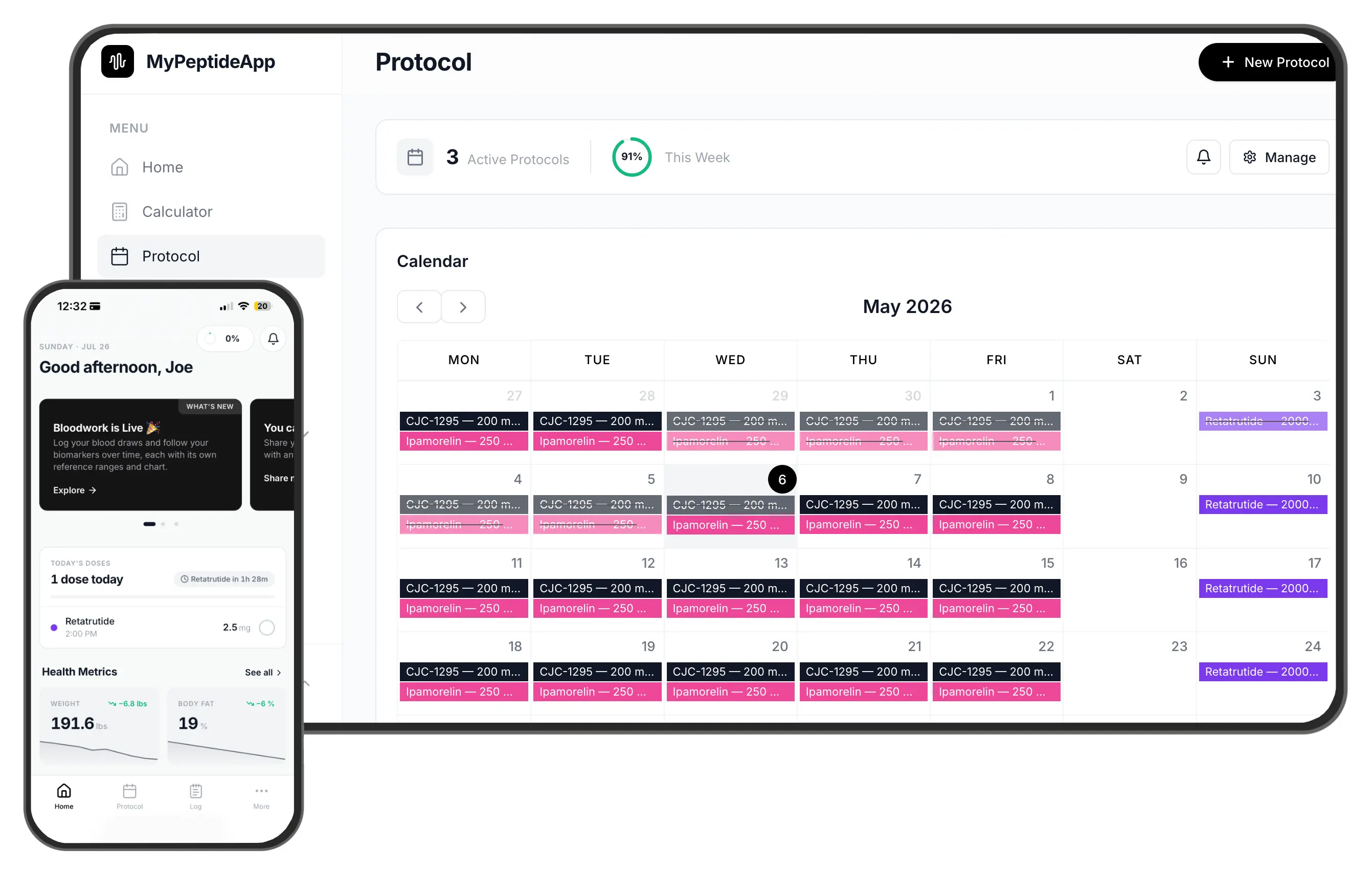
8Marketing without a warning letter
This is not a theoretical risk. In March 2026 the FDA issued 30 warning letters to telehealth companies over claims about compounded GLP-1 products on their websites, giving them 15 business days to correct.8 Another 25 followed in June.13
The cited problems are worth reading closely, because they are ordinary marketing decisions rather than exotic ones.
- Implying sameness with approved products. Describing a compounded product as equivalent, or as a generic version of an approved drug.8
- Obscuring the source. Putting your own brand name on a product in a way that suggests you compounded it when you did not.8
- Implying FDA evaluation. Any phrasing that suggests the agency has reviewed the compounded product for safety or effectiveness.8
What works instead
Education-first content, aimed at the outcome rather than the molecule. Most prospective patients do not know what a peptide is. They know they want to sleep better, recover faster or lose weight.
Local search is the highest-yield channel for an in-person practice, and the least contested. A complete business profile, real reviews, and pages built around your city rather than around a compound name.
Then the channel nobody budgets for: your existing patients. A patient six months into a programme that is working is a better acquisition channel than any ad, and they only exist if step seven worked.
9Four numbers, every week
Most practices track revenue and bookings. Those are lagging indicators. These four tell you what revenue will do next quarter.
| Metric | What it tells you | Where it usually breaks |
|---|---|---|
| Consult to start rate | Whether your offer and pricing land | Price revealed too late in the funnel |
| Month 3 retention | Whether the programme itself works | Titration support and follow up cadence |
| Refill on time rate | Adherence, and pharmacy turnaround | Nobody notices a vial running low |
| Revenue per patient per month | Whether the model is worth scaling | Per-vial pricing with no programme wrapper |
If you only look at one, make it month 3 retention. It is the earliest honest read on everything else, and it is the number that turns a service line into a business.
A realistic 90 day plan
This assumes an existing practice with a prescriber already in place. A new clinic runs the same sequence, with the medical director search and state licensing added at the front.
| Weeks | Focus | Done when |
|---|---|---|
| 1 to 3 | Model, patient, entity structure, legal review | An attorney has signed off your structure and states |
| 4 to 6 | Pharmacy vetting, clinical protocols, consents | Protocols written, pharmacy agreement executed |
| 7 to 9 | Systems, billing, patient layer, staff training | A test patient can run end to end without a workaround |
| 10 to 12 | Soft launch to existing patients only | First cohort enrolled, follow up cadence running |
| 13+ | Open marketing, weekly KPI review | Month 3 retention measurable on the first cohort |
The soft launch is the step most often skipped and the one that saves the most money. Existing patients tolerate a rough edge and tell you where it is. Paid acquisition sends strangers into the same rough edge, and they simply leave.
Frequently asked questions
Do I need to be a physician to offer peptide therapy?
What does a medical director for a peptide clinic actually do?
Is BPC-157 legal to prescribe after the July 2026 FDA vote?
What is the difference between a 503A pharmacy and a 503B outsourcing facility?
Do I need a good faith exam before prescribing peptides?
Can I run a peptide practice across multiple states?
How much does it cost to add peptide therapy to an existing practice?
Should I charge per vial or run a membership?
What software does a peptide clinic actually need?
Why do peptide and GLP-1 patients stop after a few months?
Can I advertise compounded peptides on my website?
How long does it take to launch a peptide programme?
Sources
Regulatory status in this area is moving. Every reference below is dated, and anything touching what you may compound or prescribe should be verified against the current FDA list and your pharmacy before you act on it.
- Meeting of the Pharmacy Compounding Advisory Committee, 23 to 24 July 2026. US Food and Drug Administration.
- FDA panel votes to loosen restrictions for four peptides. Pharmaceutical Executive, July 2026.
- FDA peptide compounding vote: what to watch at the July PCAC meeting. Orrick, July 2026.
- FDA to remove 12 peptides from the Category 2 do not compound list. Frier Levitt, April 2026.
- Telehealth business structure in California: corporate and compliance requirements. Bay Legal PC, May 2026.
- Navigating the 2026 peptide regulatory landscape. Holt Law, 2026.
- FD&C Act provisions that apply to human drug compounding. US Food and Drug Administration.
- FDA warns 30 telehealth companies against illegal marketing of compounded GLP-1s. US Food and Drug Administration, March 2026.
- State good faith exam requirements overview. Medical Director Co., 2026.
- Discontinuation and reinitiation of dual-labeled GLP-1 receptor agonists among US adults with overweight or obesity. Cohort study, 125,474 patients.
- More than half of those who stop GLP-1s restart within a year. Endocrine Society, ENDO 2026. Presented research, not yet peer reviewed.
- Trends in 1-year persistence and adherence among initiators of high-potency, weight loss indicated GLP-1 receptor agonists. Journal of Managed Care & Specialty Pharmacy, 2026.
- FDA's focus returns to compounding and telehealth: another wave of warning letters. Sheppard Mullin, June 2026.
Disclaimer: This guide is written for practice owners and operators. It is informational only and is not legal, regulatory, medical or financial advice. Requirements differ by state and change frequently, and the compounding status of individual peptides is actively moving. Consult a healthcare attorney licensed in the states you intend to operate in, and confirm the status of any substance with the FDA and your pharmacy before prescribing. Read the full disclaimer.